From Prototype to Partnership
You have built a working AI model. It performs well in testing, the demos look promising, and early feedback is encouraging. Yet one question remains: will anyone rely on it? Many AI ventures stall at this stage. Not because the technology fails, but rather because the surrounding structure is missing. Moving from prototype to sustainable company requires positioning, credible partnerships, and measurable impact.
The difference between a side project and a venture is rarely technical sophistication. Rather, it is the ability to operate within a real ecosystem of users, institutions, and incentives.

The Power of Partnerships
One of the strongest lessons from Building Partnerships and Social Impact Ventures is that partnerships expand capacity beyond the founding team. Early-stage founders often centralize everything: data sourcing, infrastructure, distribution, fundraising. This concentration limits perspective and slows progress.
Well-aligned partnerships strengthen core capabilities:
- Domain experts refine problem definition
- Distribution partners unlock user access
- Funding partners reinforce strategic direction
Youth founders often underestimate the importance of partnerships and try to build everything themselves.
Mapping Your Ecosystem
Mapping your ecosystem requires identifying institutions that understand the problem, organizations that provide complementary infrastructure and stakeholders whose incentives match your mission. Informed outreach builds stronger relationships and reduces friction. Ecosystem awareness also reveals regulatory expectations and collaboration opportunities that shape strategic decisions.
Positioning and Measurable Impact
AI ventures addressing social or environmental challenges operate under heightened scrutiny and impact claims require traceable logic. Make sure to define the population affected, the specific inefficiency addressed, and the scale of the issue. Develop a clear theory of change that connects product activity to measurable outcomes. If your platform connects unemployed youth with employers, link improved matching accuracy to faster placements and income stability. Each stage should be quantifiable.
Transparency and Risk Management
Impact communication requires precision.
- Present metrics with context
- State assumptions clearly
- Acknowledge data limitations
- Identify foreseeable risks
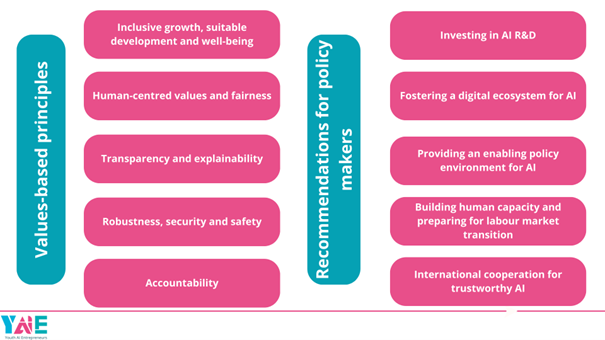
AI systems involve exposure to bias, privacy concerns, and unintended effects. Addressing these openly signals competence. Stakeholders evaluate how risks are monitored and mitigated over time. Consistency in responsible practice reduces perceived uncertainty. Remember that lower uncertainty strengthens investor confidence and partner trust.
Communication and Public Presence
Communication is an operational requirement, so, when engaging investors or partners:
- Establish context and urgency
- Define the problem clearly
- Present your solution in accessible language
- Demonstrate evidence and learning
- Respond to difficult questions with structured reasoning
Public documentation further strengthens trust. Whether it be publishing case studies, sharing pilot results or documenting iterations – create a visible track record. Platforms such as LinkedIn, GitHub, Kaggle, and Hugging Face function as credibility layers that display thinking and execution over time.
AI lowers barriers to product development. Competitive advantage increasingly depends on structure and disciplined execution. Scaling a venture requires strategic partnerships, integrated impact and revenue measurement, transparent governance and clear communication. While a prototype demonstrates possibility, a venture demonstrates reliability and sustained relevance. The transition between the two is defined by collaboration and trust.
Bibliography
Organisation for Economic Co-operation and Development. (2019). OECD principles on artificial intelligence. OECD Publishing. https://www.oecd.org/going-digital/ai/principles/
United Nations. (2015). Transforming our world: The 2030 agenda for sustainable development. United Nations. https://sdgs.un.org/2030agenda
United Nations. (n.d.). Sustainable Development Goals. https://sdgs.un.org/goals
European Commission High-Level Expert Group on Artificial Intelligence. (2019). Ethics guidelines for trustworthy AI. European Commission. https://digital-strategy.ec.europa.eu/en/library/ethics-guidelines-trustworthy-ai